

Some cities are remembered for their monuments.
Others for the ideas they inspired.
Few places have shaped modern thought as profoundly as Vienna around 1900. It was a city where artists, scientists, architects and philosophers lived not only side by side, but often around the same café tables. The conversations that unfolded there would influence disciplines ranging from psychology and economics to music, architecture, and design.
Niklas Schmidt has developed a distinctive way of revisiting that remarkable period. Through a series of posts shared on LinkedIn, he explores the people, buildings and ideas that made Vienna one of history’s great intellectual crossroads. Interestingly, he does so by combining historical research with artificial intelligence - a tool to help bring stories back into public conversation.
We spoke with him about cities, memory, architecture, AI, and why curiosity remains one of civilisation’s greatest engines.
The Art of Choice: Niklas, some of your posts often begin with the same sentence: “I love my city. Vienna was the intellectual capital of the world around 1900.” What first drew you to this particular chapter of Vienna’s history?
Niklas Schmidt: Actually, I had recently done a visit to the Leopold Museum in Vienna, one of many incredible museums we have in this fabulous city. In one room, there was a wall with 100 or so famous people in Vienna around 1900. I loved going through their stories. Most of them were well-known to me, but a few were not. When I came back home, I thought it would be good to do a kind of series on Vienna around 1900 on LinkedIn – for my LinkedIn readers but also for myself. That was how I started this project.
“History should never become a museum piece.” - Niklas Schmidt
Looking at Vienna around 1900, one is struck not only by the brilliance of individual thinkers, but by the concentration of ideas in a single place. What do you think makes a city a cultural and intellectual incubator?
Vienna benefited from being the capital of a vast empire. It attracted scientists, artists, and entrepreneurs from across Europe. In the cafés, conversations often lasted for hours. Innovation often begins with curiosity, and curiosity flourishes where people meet other people with maybe strange ideas.
Niklas’ stories rarely focus on architecture alone. They are equally about what societies choose to remember - and how places can acquire new meaning over time.
Many of the stories you tell are not only stories of buildings, but stories of transformation: neglected places brought back to life, difficult memories transformed into part of a city’s identity. Why do you think societies need to transform their past rather than simply preserve it?
History should never become a museum piece. Every generation inherits buildings, institutions, and traditions, but also difficult chapters that cannot be ignored.
“Innovation often begins with curiosity, and curiosity flourishes where people meet other people with maybe strange ideas.” - Niklas Schmidt
Many of the buildings you write about are still beautiful today. What can architecture preserve that books and archives sometimes cannot?
Buildings connect us emotionally to history. They remind us that the people who lived hundreds of years ago were real people with ambitions, fears, and dreams.
If cities preserve ideas, technology changes how we rediscover and share them. Niklas has openly embraced artificial intelligence as part of his creative process, while remaining clear about where responsibility ultimately lies.
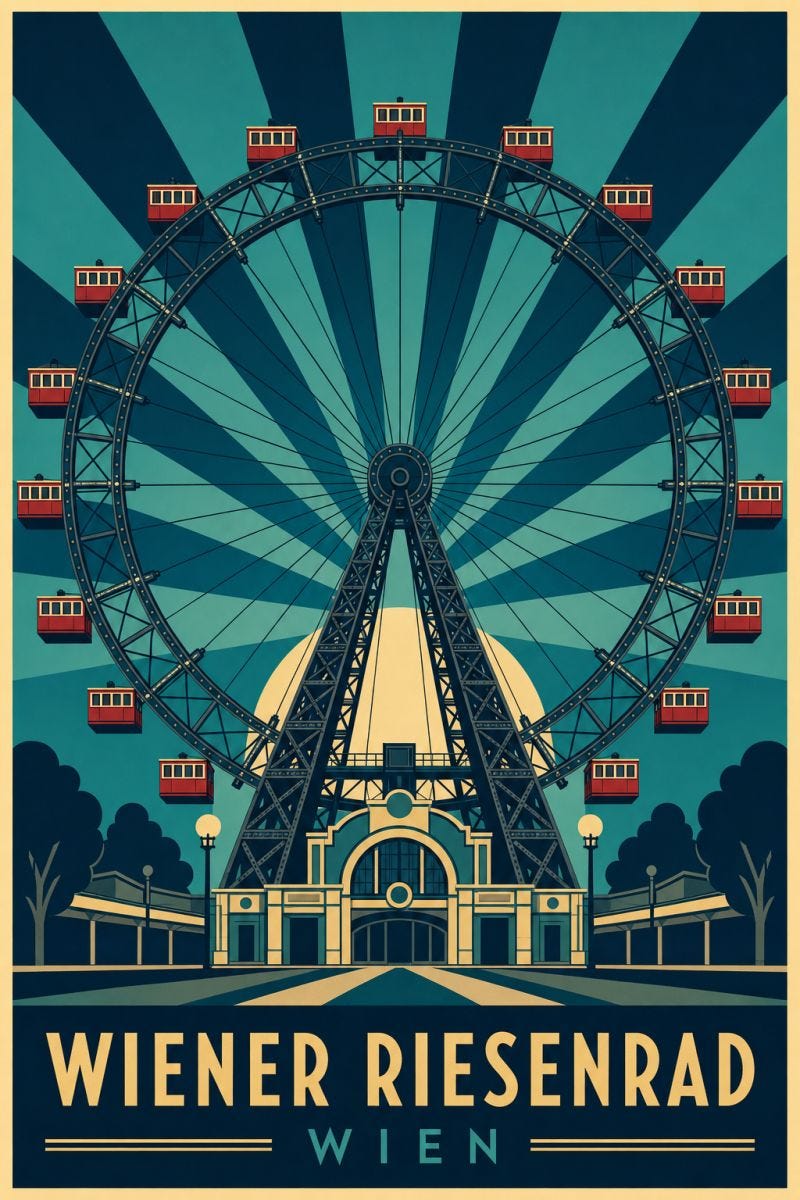
Image: The Vienna Giant Ferris Wheel, represented through AI in one of the suggestive LinkedIn posts of Niklas. Courtesy of Niklas Schmidt.
Interestingly, your stories about Vienna are researched and written with the support of artificial intelligence, and the accompanying images are AI-generated in a distinctive visual style. Do you see AI primarily as a productivity tool, or as a new way of engaging with cultural memory? And where, in your view, does human responsibility ultimately lie?
AI is an extraordinary productivity tool. But it is always my responsibility. Nothing is posted by me on LinkedIn that I would not defend.
Vienna around 1900 helped shape many ideas that still influence us today. Looking ahead, what ideas being developed today do you believe future generations may look back on as transformative?
I believe AI will define this era in much the same way electricity defined the nineteenth century or the internet defined the late twentieth. What excites me most is not simply automation. It is augmentation.
To know more about Niklas’ work, visit:
After reflecting on history, technology and the future, we asked Niklas one final question: if a visitor had time for only one place in Vienna, where should they begin?
If you had to recommend a busy visitor only one must-see building in Vienna, which one would it be and why would you recommend it?
Without hesitation, St. Stephen’s Cathedral. It has stood at the heart of Vienna for centuries and has witnessed almost every defining moment in the city’s history: Romanesque foundations, Gothic architecture, Ottoman sieges, imperial ceremonies, wartime destruction, and post-war reconstruction.
And finally: what does it mean, for you, to choose well?
Making a decision which I will not regret 10 years from now.
History is often described as something we inherit. This conversation reminds us that we also inherit the responsibility to interpret it, question it, and pass it on.
Whether through architecture, conversation, or new technologies, cultural memory survives because each generation chooses to engage with it rather than simply preserve it.
Every city has its landmarks.
But its greatest legacy is often the curiosity it continues to inspire.
Technology may help us find information. Principles help us keep our compass. Curiosity helps us discover meaning.
What has curiosity led you to discover lately?
We would be glad to read your thoughts.