

The happiness of receiving something that has already been loved.
That has a history.
Someone chose it, carried it, enjoyed it. Now that pleasure can become ours.
This is the story of a shoulder bag, a remarkable Italian creative mind, and two generations of women who found happiness in the same object.
A flower made of leather
The bag is impossible to mistake for an ordinary one.
Its flap is shaped like an enormous flower, with rounded petals and a delicate botanical drawing traced into sturdy leather. Thick leather strips stitch its edges together. A long shoulder strap allows it to rest against the hip, while the rich reddish-brown colour has acquired the particular character that only time can give to leather.
It belonged to the mother of Roberta Tondini, and, around twenty years ago, it was passed into Roberta’s hands.
She began carrying it herself, making it part of her own wardrobe and her own life.
She still has it today, and cares for it with affection.
A continuity as simple as it is remarkable: a bag that was enjoyed so much by one woman became a source of joy to another. Its history acquired another chapter.
The world according to Elio Fiorucci
The bag is an early expression originating from the world of Elio Fiorucci, one of the most original figures in twentieth-century Italian fashion.
Today, his name immediately brings to mind colourful graphics, playful imagery, the famous two angels, and jeans that helped transform the way women dressed.
But to understand his influence, we have to imagine Milan in the 1960s.
Fashion was still governed by a certain idea of elegance and taste. Clothes could communicate status, and the boundaries between fashion, art, music, and everyday life were more clearly drawn.
Fiorucci imagined something different.
A visit to London introduced him to the extraordinary energy of the Swinging Sixties: Carnaby Street, young people inventing their own style, and the possibility that fashion might be spontaneous, irreverent, and fun.
In 1967, he opened his first shop in Milan’s Galleria Passarella, near Piazza San Babila.
The store hosted unexpected objects, clothes, music, colours, and influences arriving from other parts of the world. It quickly became a place to explore, to meet, to discover things one had never imagined.
Even the opening became an event, with singer Adriano Celentano arriving in a pink Cadillac.
Fiorucci was doing something that now seems familiar, but was genuinely revolutionary then: he was creating an entire world around a way of living.
His Milanese stores became gathering places for a generation, and his ideas soon travelled much further.
In 1976, Fiorucci opened in New York. The store became a meeting point for artists, performers, designers, and people shaping the city’s cultural life. Andy Warhol was among the personalities associated with that extraordinary world.
Fiorucci understood that a shop could be a place where culture happened. And his influence extended to the clothes themselves.
His approach to women’s jeans helped turn denim into a modern phenomenon. The famous stretch jeans challenged conventions about how women could dress and move.
And the two little angels, adapted from Victorian imagery into the brands’ unique graphic identity, became symbols recognised globally.
There was cheeky humour in his work, as well as the not-so-subtle hint that fashion did not need to be solemn to matter.
This is how Elio Fiorucci helped make fashion freer.
Perhaps this is why the flower-shaped leather bag feels so much at home in his universe. A flap becomes a flower, seams become part of the decoration: a shoulder bag that brings a smile.
An initial expression of the same curiosity that made Fiorucci’s larger world so influential.
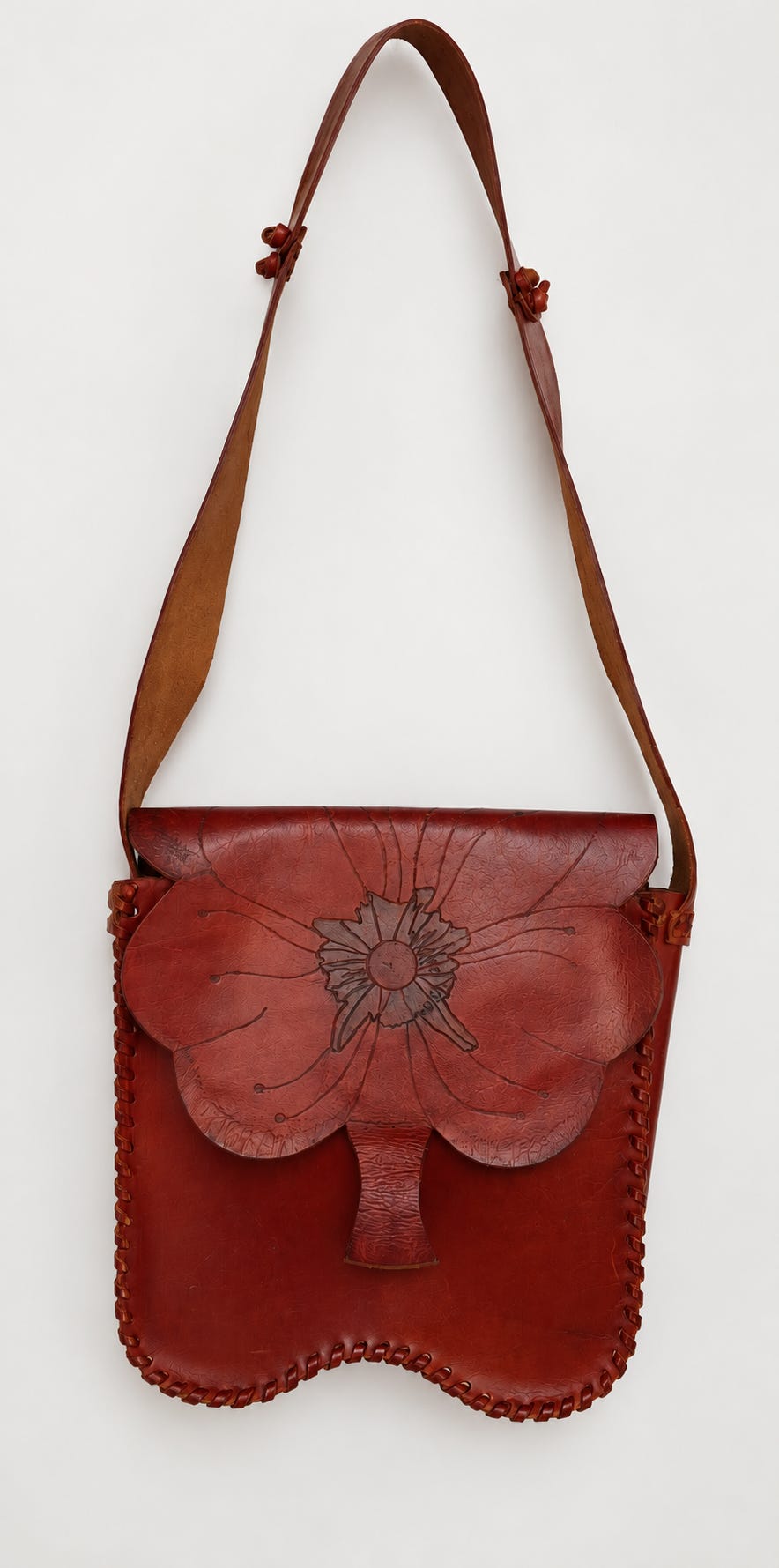
Image: The early Fiorucci shoulder bag mentioned in this article. A flower carved in leather, a lifetime of stories, and the joy of being loved across generations. From the personal collection of Roberta Tondini.
The pleasure of choosing
Roberta’s mother was attracted to it by its highly visible craftsmanship, including the hand-carved lines of the flower.
She chose a bag that she enjoyed using, and that it eventually found a second life with her daughter.
We speak frequently today about buying less, choosing better, repairing, preserving, and extending the life of what we own.
This bag is a living testimony to those ideas, and it also reminds us that the pleasure of a lasting object sometimes begins with delight.
With recognising something well made, something that feels right, choosing it, and enjoying it so much that replacing it never becomes a topic.
Over time, the marks of use become part of its character. And when it passes to someone else, those marks become part of what makes it irreplaceable.
What we value
The value of this bag is difficult to measure.
It is not simply a vintage Fiorucci accessory, its significance lies in the fact that it has continued to be used and enjoyed.
For Roberta, carrying her mother’s bag is a way of continuing a gesture and discovering a pleasure that two people can share across time.
Elio Fiorucci left an enormous cultural legacy. His vision travelled from Milan to the world, influencing the way people dressed, shopped, expressed themselves, and thought about fashion.
His ideas became part of the visual language of an era.
This little flower-shaped bag represents that kind of legacy in a different way, having travelled across generations and places, years and styles.
Perhaps that is one of the most beautiful possibilities of choosing well.
We cannot know which of the things we buy today will still be with us decades from now. Nor can we predict which will matter to someone else.
But sometimes a choice made for the simple happiness of the moment becomes something much larger.
Is there something you were passed on that you love not only for its memories, but for the happiness of using it yourself?
We would be glad to read your thoughts.