

There are lives that follow a clear trajectory.
And others that unfold along parallel lines - in a fine balance.
Ayed Tadros belongs to the latter.
A lawyer by profession and a photographer by practice, his path does not fit into a conventional narrative. And yet, it is precisely in this apparent duality that something more deliberate emerges: a way of living shaped not by a single identity, but by the conscious decision to cultivate more than one.
In a world that often rewards linearity, choosing to dedicate time and attention to something that does not “need” to exist may appear secondary. And yet, it is often exactly there - in that voluntary space, ungoverned by obligation - that meaning begins to take form.
Ayed moves between legal structures and photographic frames with the same underlying discipline: the capacity to observe, to select, to commit. His images carry the quality of considered decisions. Nothing forced. Nothing incidental.
What follows is a reflection on time, attention, discipline, and the quiet architecture of a life shaped with intention.
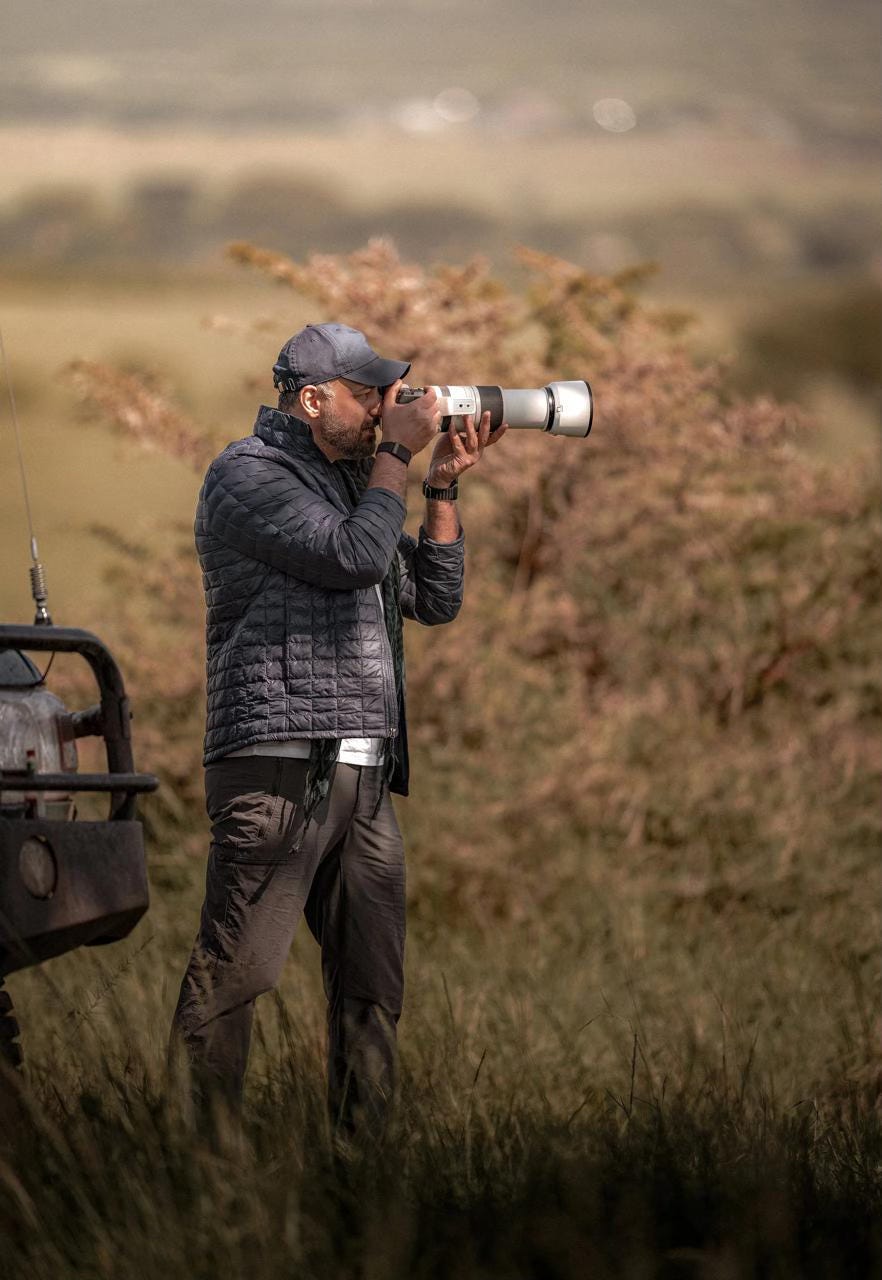
Image: Ayed Tadros captured behind the camera. Courtesy of Ayed Tadros Photography.
The Art of Choice: Ayed, you are both a lawyer and a photographer - a path that may not appear linear to most. At what point did photography become more than an interest, and turn into a deliberate life choice?
Ayed Tadros: Photography was always present, but for a long time it lived quietly in the background. Something instinctive rather than intentional. The shift happened gradually, not as a single decision, but as a realization.
There comes a point where you notice that what you return to, consistently, is not accidental. Despite a demanding legal career, I kept finding myself behind the camera - early mornings, late evenings, across different countries, in wild moments where most people would choose rest. That repetition revealed something deeper: photography was not an escape from my profession, as I once believed; it was a necessary counterpart to it.
Photography became a deliberate choice when I stopped treating it as something secondary. Not in the sense of replacing my career, but in giving it equal seriousness. Investing in it, refining it, building a body of work. At that point, it was no longer a hobby. It became part of how I as a person is defined, and how I define a meaningful life.
In a life already shaped by a demanding profession, how do you think about time - and what it means to invest it in something that does not “need” to exist?
I think the things that “do not need to exist” are often the only things that truly matter.
My profession is structured around necessity: transactions, regulations, outcomes. Photography exists outside of that framework. It has no obligation to solve anything, and precisely for that reason, it creates space for something else: reflection, emotion, perspective.
Time, for me, is not only about productivity. It is about allocation of attention. And attention is finite. Where you choose to place it ultimately defines the texture of your life.
So I don’t see photography as time taken away from something more important. I see it as what prevents life from becoming purely functional. Without it, everything risks becoming efficient, but empty.
Do you believe that a life can be consciously designed?
To a certain extent, yes - but not in a rigid or overly controlled way.
You cannot design outcomes, but you can design direction. You can decide what you value, what you return to, and what you are willing to invest in consistently over time.
For me, photography is one of those anchors. It introduces a different rhythm into a life that would otherwise be dominated by urgency and structure. It forces me to slow down, to observe, to be present in places and moments I might otherwise pass through without noticing.
In that sense, it is not separate from how I shape my life. It is one of the tools through which I do it. It keeps the balance. It keeps things human.
“The things that do not need to exist are often the only things that truly matter.” - Ayed Tadros
Every art and craft requires repetition - often invisible, often solitary. What has the practice of photography taught you about patience, attention, or even restraint?
More than anything, it has taught me that not everything needs to be taken.
In the beginning, like many people, you feel the urge to capture everything, to respond immediately to what is in front of you. Over time, you realize that the discipline is not in taking more images, but in taking fewer, better ones.
Patience becomes less about waiting, and more about understanding timing. When to press the shutter and when not to. Attention becomes more selective. You start seeing layers: light, movement, emotion, context.
Also, restraint becomes essential. The strongest images are often the result of what you chose to leave out, not what you included.
Photography, in that sense, is a continuous exercise in editing. Not just of images, but of perception and how you view the world around you.
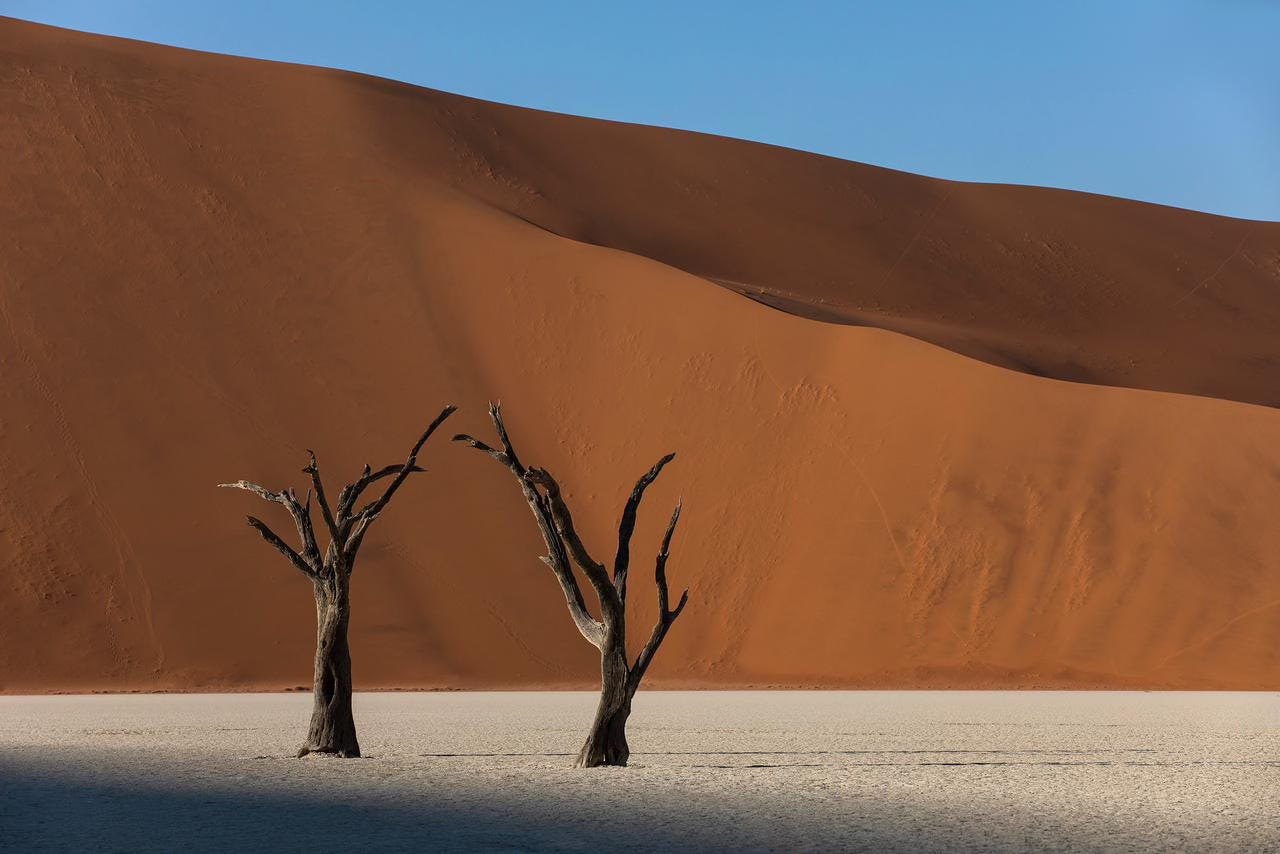
Image: Namib-Naukluft Park, Deadvlei, Namibia. Courtesy of Ayed Tadros Photography.
Photography is, in essence, an act of selection. What guides your eye when you choose what is worth capturing - and what is not?
It’s rarely a rational process. There is usually a moment, a very brief one, where something aligns. Light, subject, emotion, composition. You feel it before you fully understand it.
Over time, you learn to trust that instinct. But it is not purely intuitive. It is informed by experience. By thousands of frames that did not work. By being in different environments, cultures, and situations.
What I tend to respond to most is honesty. Whether it is a landscape, a city, or a person, there has to be something real in it. Not staged, not forced. Something I felt.
If an image feels like it is trying too hard, I usually step away from it. If it feels quiet but genuine, that is often where I stay.
To know more about Ayed’s art, visit:
If you had to define it simply: what does it mean, for you, to choose well?
I have to say I am not sure I have fully arrived at that yet.
I tend to be a perfectionist. I revisit decisions, question them, and sometimes look at what I didn’t choose. So, for me, choosing well is less a fixed state and more something I am learning.
What I have come to understand is that choosing well requires a certain level of acceptance. Not every decision will be perfect, and clarity often comes after, not before.
In photography, that might mean staying with one frame and letting go of the others. In life, it means committing to a direction without needing to constantly validate it against alternatives. It can also mean trying to build something meaningful and with depth rather than spreading yourself too thin.
I am still working on that balance between being thoughtful and being at peace with a decision. But perhaps choosing well is exactly that: knowing when to stop searching and start standing behind what you have chosen.
There is a clear honesty in not claiming certainty.
In a world that often equates decisiveness with clarity, this perspective suggests something else: that choosing well may not be about eliminating doubt, but about learning to live with it.
As in photography, it is not the number of possibilities that defines the outcome, but the ability to stay with one frame long enough for it to reveal its depth.
“Perhaps choosing well is knowing when to stop searching and start standing behind what you have chosen.” - Ayed Tadros
What does it mean, for you, to choose well?
We would be glad to read your thoughts.