

Humankind created brands as a form of promise.
A shoemaker’s mark.
A watchmaker’s signature.
A family name engraved on a storefront.
The promise was simple: “I made this. I stand behind it.”
A brand reduced uncertainty. It gave people confidence that an object would perform as expected and that its maker cared about its reputation.
In many ways, brands emerged because trust could not travel in person.
The brand travelled instead. In doing so, it became trust made visible.
Today, brands are everywhere.
We encounter hundreds of them each day.
They speak to us through our phones, our computers, our cities, our social media feeds.
They have become extraordinarily sophisticated storytellers.
And perhaps this is where an interesting question begins to emerge: Is a promise still a promise?
Modern consumers live in an age of unprecedented information.
Yet many of us have never felt less certain about what we are buying.
A cosmetic product may contain ingredients whose names we cannot pronounce.
A food item may display health claims we struggle to evaluate.
A garment may tell us a compelling story while revealing little about its actual making.
A product may be expensive without necessarily being valuable.
A name may be omnipresent without necessarily being trustworthy.
Visibility and value have become increasingly difficult to distinguish.
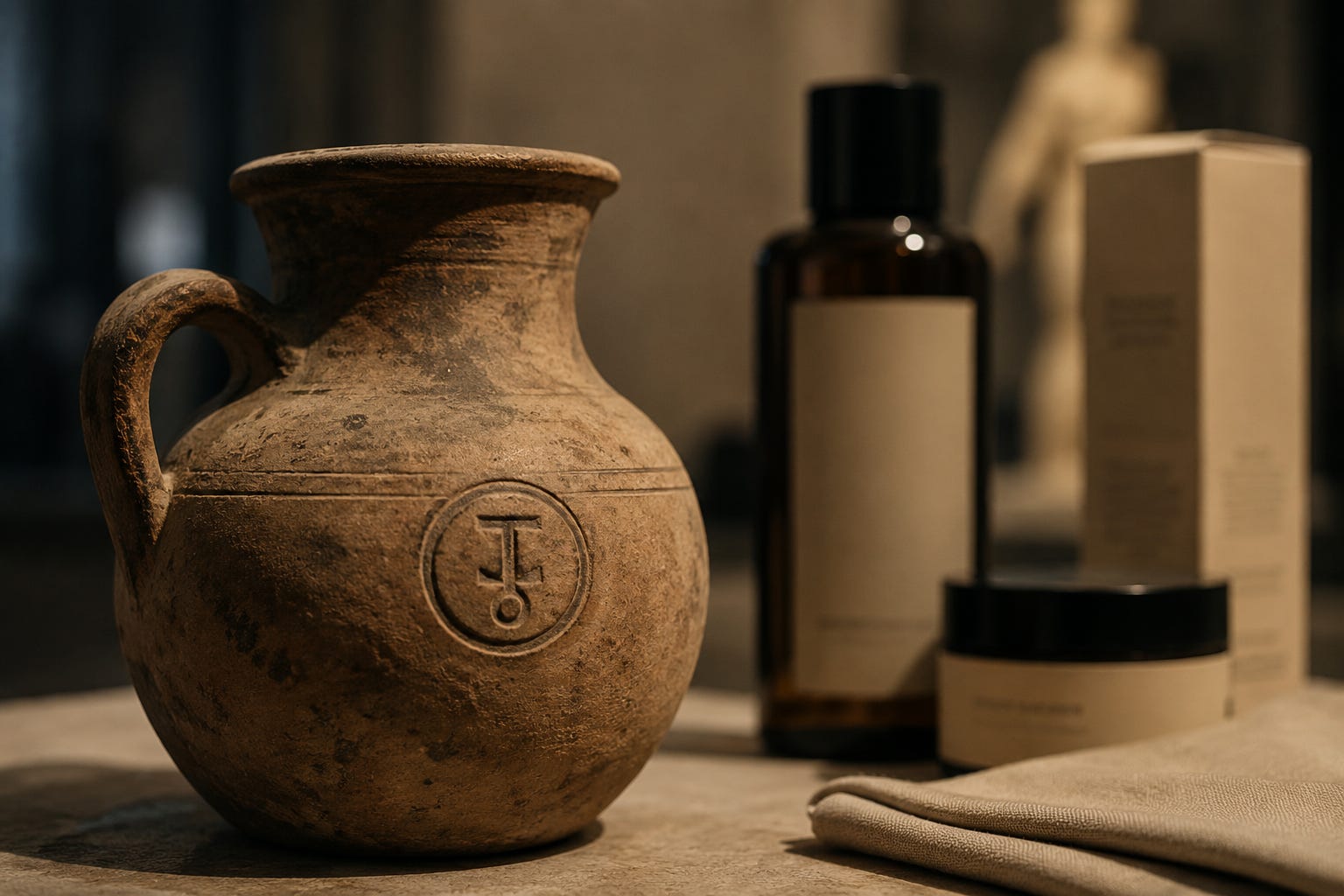
Image: An ancient object and modern products. Different eras, the same human desire: to know what - and whom - we can trust. Image generated through AI.
Perhaps this explains the success of platforms such as Yuka and other tools that seek to decode products for consumers.
Whether one agrees with every methodology these platforms employ is almost beside the point.
What they reveal is something fascinating: millions of people increasingly feel the need for interpreters, intermediaries, translators. People and technologies capable of helping them understand what lies behind complex labels, technical language, and carefully crafted narratives.
This is a remarkable inversion.
Historically, brands existed to simplify trust. Today, consumers often seek additional tools to verify it.
Of course, none of this means that branding is inherently misleading.
Many extraordinary brands continue to invest deeply in quality, knowledge, craftsmanship, innovation, and service.
Nor does it suggest that marketing is somehow opposed to substance.
The two can coexist beautifully.
The challenge is that modern systems have become exceptionally effective at manufacturing appearances.
The symbols of value are often easier to produce than value itself.
Beautiful packaging, compelling storytelling, omni-channel visibility, sophisticated messaging, cultural relevance.
All of these things can accompany exceptional products.
They can also exist independently from them.
Historically, brands existed to simplify trust. Today, consumers often seek additional tools to verify it.
This phenomenon extends far beyond fashion.
It touches food, beauty, consumer goods, hospitality, technology, and even health.
In many industries, consumers increasingly find themselves asking difficult questions:
Am I paying for quality? For advertising? For convenience? For aspiration? For an algorithm that succeeded in placing this object in front of me at precisely the right moment?
Perhaps this is why the notion of a brand as a promise still matters.
Not because promises have disappeared. Every brand still makes one.
The question is whether there remains a meaningful relationship between the promise and the product, service, or experience itself.
Because trust has always required alignment between words and actions.
Perhaps the modern consumer’s task is no longer simply choosing what to buy.
Perhaps it is learning how to recognise coherence and to ask what sits behind the narrative.
To ask whether the object, service, or the experience still carries traces of the care it promises.
Because a promise becomes meaningful only when someone intends to keep it.
When you encounter a brand today, what makes you trust it?
We would be glad to read your thoughts.