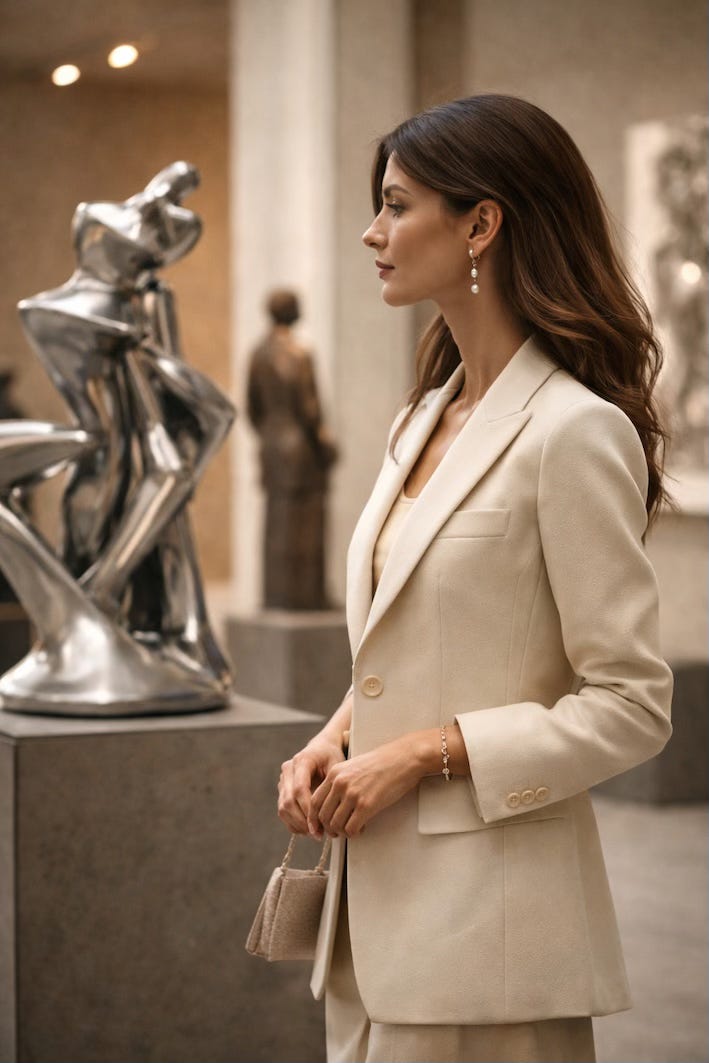
There was a time when displaying wealth too openly was considered inelegant. Not because wealth itself was shameful, but because refinement implied discretion.
Luxury was something one felt, not something one performed.
In recent years, the fashion conversation has been dominated by the rise of Quiet Luxury: a return to muted tones, impeccable tailoring, and the absence of logos. It emerged almost as a cultural antidote to the saturation of streetwear and visible branding.
For a moment, it felt like a collective exhale.
And yet, as with every aesthetic movement, the risk lies in reduction.
When “quiet” becomes merely another marketing device, it can drift into what might be called plain luxury: visually restrained, yes, but still engineered for margin rather than meaning.
The problem is not the absence of logos, rather, the absence of intention.
In parts of the Middle East, the idea of modest luxury has quietly shaped contemporary fashion conversations. Here, modesty does not mean austerity. It means garments and objects that honor cultural codes while embracing exquisite craftsmanship and material richness.
Luxury, in this context, becomes an inward satisfaction rather than an outward declaration. It respects the social fabric as much as the physical one.
And perhaps this is what feels increasingly relevant.
Because the opposite of ostentation is not minimalism.
It is consideration.
Reasonable luxury asks a simple, almost disarming question:
Who is this for?
If the answer is “for others to see,” something essential may already be missing.
If the answer is “for the personal pleasure of living well,” the gesture changes entirely.
Historically, what made Made in Italy revered was not excess. It was craft that privileged material integrity over spectacle. Objects designed to age beautifully, not to dominate a room.
That was luxury as social intelligence.
To enter a space without overwhelming it.
To choose quality without turning it into a performance.
In an era of awareness, the most radical choice may be respect.
Respect for the artisans behind the object.
Respect for oneself - choosing durability over impulse.
Respect for others - refusing to reduce value to visibility.
Reasonable luxury does not reject success. It refines its expression.
It asks us to consider whether elegance might once again be measured not by what we display, but by what we quietly sustain.
Perhaps the real return is not to “quiet luxury,” but to considered luxury.
The kind that simply endures, for the pleasure of it.
What does luxury mean when no one is watching?
We welcome your thoughts.