
Saying No to a Disposable Life
Or, when did lasting become the exception?

There is a particular kind of disappointment that belongs to modern life.
The toaster that stops working shortly after its warranty expires.
The sweater that looked beautiful in the shop and loses its shape after three washes.
The suitcase whose wheel cannot be replaced.
The chair that survives perfectly well - until it has to be moved.
None of these things were necessarily cheap.
None of them were necessarily advertised as disposable.
And yet, somehow, they were.
We have become accustomed to discussing disposability through its most obvious expressions, like single-use plastics, fast fashion, or products so inexpensive that repairing them would cost more than replacing them.
But disposability does not always look disposable.
Sometimes it comes beautifully packaged. Sometimes it carries an appealing story. Sometimes it is expensive. Sometimes it bears the name of a country with a centuries-old reputation for making that particular kind of object well.
And sometimes we discover only much later that what appeared to be made for years was really made for seasons, or even months.
For much of modern history, progress has given us a genuinely better life.
But somewhere along the way, perhaps we have become less accustomed to asking an important question: How much life is there in the things we buy?
Europe has begun asking a version of this question through legislation.
The European Union is extending the idea of ecodesign far beyond energy consumption, creating a framework that considers durability, reparability, reusability and maintenance. It is also strengthening the right to repair and addressing practices linked to the premature obsolescence of goods.
It is an interesting shift: from asking what happens after we throw something away to asking why we needed to throw it away so soon.
Read more about the European legislation:
Fashion offers an especially revealing example.
We know what fast fashion looks like, as its consequences have been extensively documented and are increasingly understood.
But what should we make of a beautifully presented product whose quality is difficult to assess?
“Made in Italy”, “Made in France” or “Swiss Made” can tell us something important about an object’s origin and the traditions surrounding its making.
Yet, origin alone cannot tell us how well something was made. A place renowned for excellence can produce different levels of quality, just as a high price can reflect many things besides the intrinsic quality of an object.
Perhaps we need to become interested in details again.
What exactly is this made from?
Not simply leather, but what kind and what quality?
Not simply wool, but what fibre, construction and finish?
What are the components involved?
How was the object assembled?
Was it designed to age - or merely to remain attractive long enough to be sold and survive a limited period of use?
These questions require more effort than recognising a logo or reading a country-of-origin label.
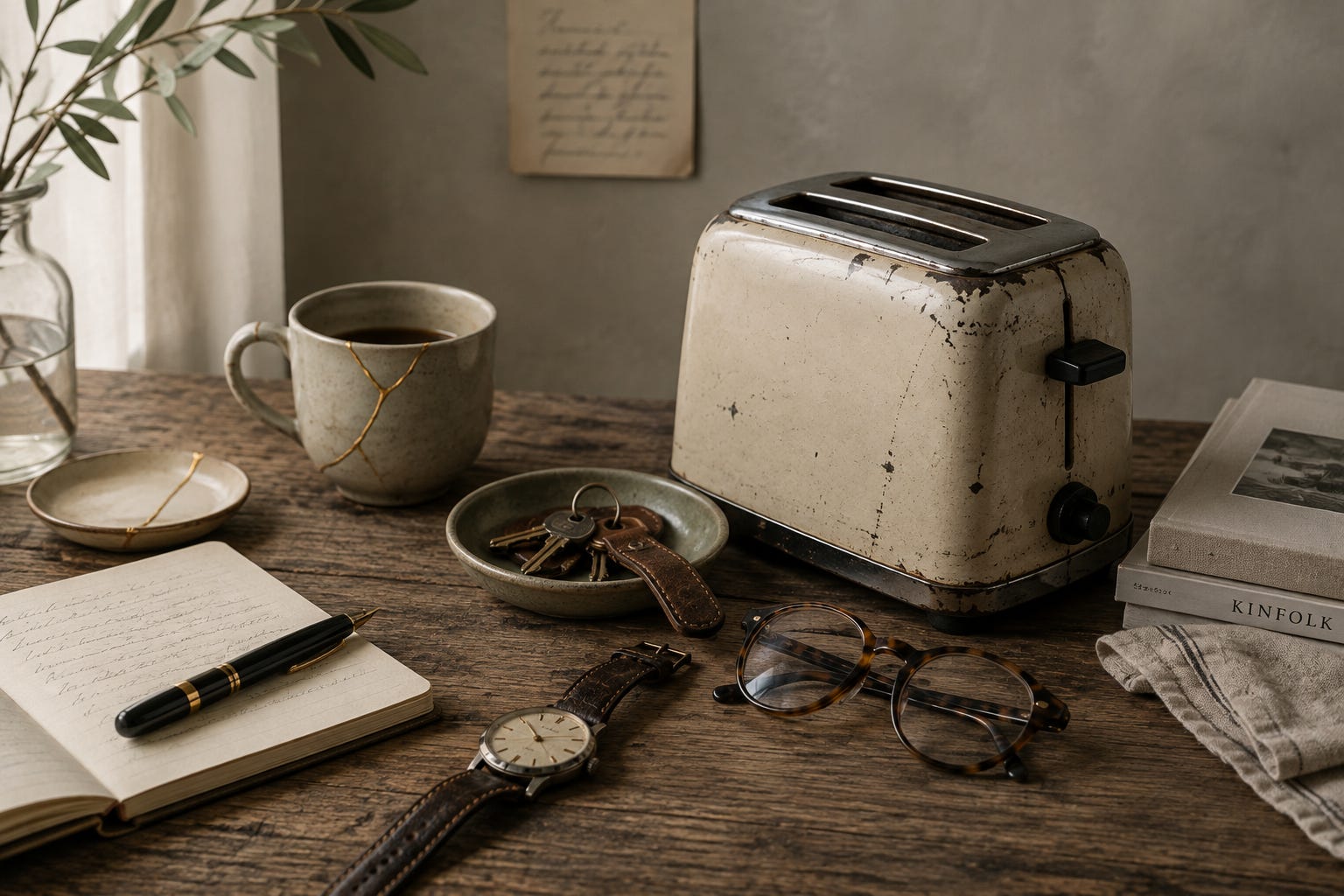
Image: A still life of everyday objects made to last, bearing the traces of time and use. Image created with AI.
And what happens to us when almost everything around us is designed to be replaced?
We replace objects when they break. Sometimes before they break.
We replace interiors because fashions change. We buy things for occasions rather than lives. We consume images for seconds before moving to the next. We swipe from one person to another.
Could a culture of replacement eventually shape the way we relate to people, too?
There is nothing inherently wrong with novelty and the question is not whether we should reject modernity.
It is whether replacement has become our default relationship with the world around us.
Perhaps saying no to a disposable life begins somewhere surprisingly modest.
With curiosity.
Not simply:
Do I like it? Or: Can I afford it?
But:
What is it made of? How was it made? Can it be cared for? Can it be repaired? What might it look like after years of use?
And, perhaps most importantly: Was this made to stay?
Choosing something that lasts will not always mean choosing the most expensive option or the most famous name.
And it certainly does not require surrounding ourselves only with precious objects.
What matters may simply be recovering the expectation that the things entering our lives should be worthy of remaining there, and worthy of the time we spent choosing them.
And perhaps choosing well sometimes means choosing what does not need to be next.
What is something you own that has become more valuable to you with time?
We would be glad to read your thoughts.