

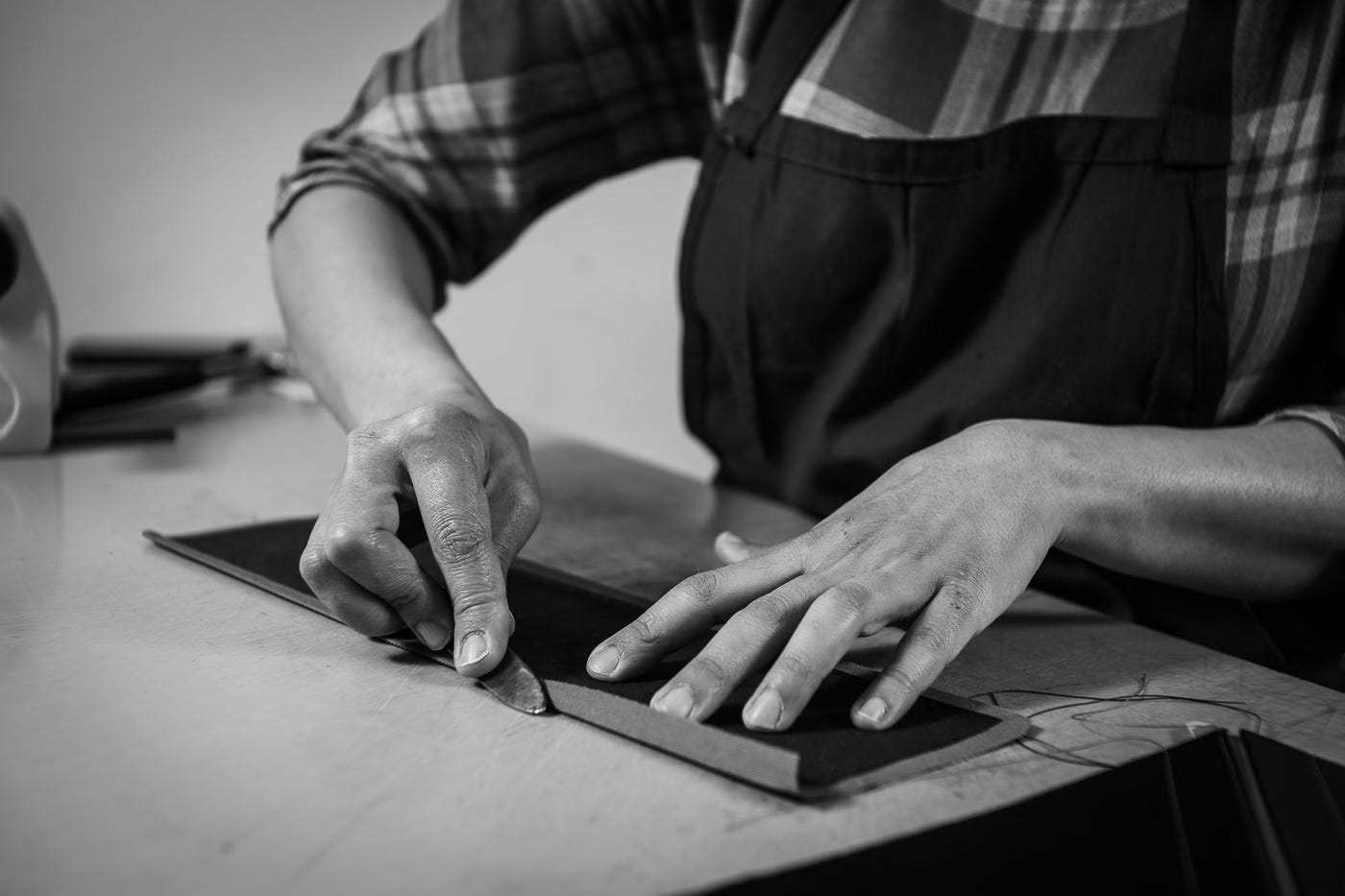
Image: Hands of a craftswoman working on a Studio Tondini item.
There was a time when making something required waiting.
Today, we live in an era in which speed has become our default language.
And in many ways, it is extraordinary. It allows us to connect across continents, to access knowledge instantly, to compress distances that once defined our lives.
But something else has quietly shifted.
When everything becomes immediate, our relationship with time begins to flatten.
And with it, our relationship with effort, with patience, and perhaps even with meaning.
There is a word that carries a different rhythm: craft.
It is almost onomatopoeic.
You can hear it.
The friction of materials.
The measured repetition of a gesture.
The sound of something taking shape, slowly.
Craft, crafting, craftsmanship: they all point to a way of doing that resists urgency.
In craftsmanship, time is not something to optimise.
It is something to honour.
Think, for a moment, of the last time you made something with your hands.
Perhaps as a child: assembling, drawing, building without knowing the outcome.
Or later, trying to translate an idea into something real.
There is always a moment in that process where things do not work.
Where the material resists.
Where the idea feels slightly out of reach.
And yet, that is precisely where something happens.
A form of attention that cannot be rushed.
A quiet satisfaction that does not come from completion alone, but from engagement.
Objects created slowly carry this memory within them - perceptibly so.
You feel it in the balance of proportions.
In the way something ages without losing its integrity.
In the absence of excess.
These are objects that teach us how to remain still.
The tradition of craftsmanship - particularly within the heritage of Made in Italy, a tradition we feel deeply connected to - is built on this relationship with time.
Skills passed through generations.
Gestures refined, rarely reinvented.
An understanding that excellence is not an outcome, but a practice.
This kind of knowledge cannot be accelerated.
It can only be transmitted, observed, repeated.
And perhaps that is why it feels increasingly rare, and increasingly necessary.
To return to slow objects is not to reject modern life.
It is to rebalance it.
To allow certain things to take the time they require.
To recognise that not everything meaningful can - or should - be immediate.
Perhaps, in the coming days, there is a small gesture worth revisiting.
An object you once made.
A tool you once used.
A material you once shaped.
To pick it up again. To craft.
What have your hands learned that speed has made you forget?
We would be glad to read your thoughts.