

There is something paradoxical about the age we live in.
Never before have we had access to so much information about health, nutrition, and longevity.
And yet, never before have modern societies seemed so disconnected from many of the principles that once allowed human beings to live longer, stronger, and more balanced lives.
Somewhere along the way, abundance replaced discernment.
Convenience replaced rhythm.
And nourishment became increasingly confused with consumption.
For centuries, food cultures evolved through observation, repetition, and trial-and-error across generations.
Long before scientific journals or nutritional labels existed, populations slowly discovered what sustained the body best: seasonal ingredients, moderation, fasting periods, legumes, grains, vegetables, fermentation, slow preparation.
These traditions were built around continuity between human beings and nature.
“Somewhere along the way, nourishment became increasingly confused with consumption.”
It is perhaps unsurprising, then, that many contemporary researchers looking toward the future of health have found themselves studying the past.
Among them is Professor Valter Longo, researcher and author of The Longevity Diet, whose work bridges biology, ageing, and nutrition. Through decades of scientific research, Prof. Longo has explored how certain nutritional patterns - many of them deeply rooted in traditional Mediterranean and ancestral dietary habits - may help support long-term health and reduce the risk of modern chronic diseases.
Beyond research itself, Prof. Longo’s work also carries a broader mission: making the science of longevity accessible beyond laboratories and academic circles. Through his studies, public initiatives, and educational efforts, he has consistently argued that living longer should not simply mean extending lifespan, but extending healthy lifespan - what researchers often define as “healthspan”.
In this sense, his work is not only about nutrition. It is about responsibility toward the future self.
Those interested in exploring Longo’s research further can find more through his books, scientific publications, and public initiatives:
What makes Prof. Longo’s work particularly interesting is not only the science itself, but the rediscovery embedded within it: the idea that longevity may depend less on constant optimisation, and more on returning to rhythms the human body has long understood.
“Prof. Longo’s work is about responsibility toward the future self.”
To nourish oneself well requires something increasingly rare: attention.
Time to select ingredients carefully.
Time to cook.
Time to sit down without distraction.
Time to understand what the body responds to, and what it rejects.
In this sense, nourishment becomes more than health.
It becomes a relationship with oneself.
And perhaps this is where the conversation connects back to choice.
Because every form of care ultimately demands selection:
what we consume, what we repeat, what we normalize, what we refuse.
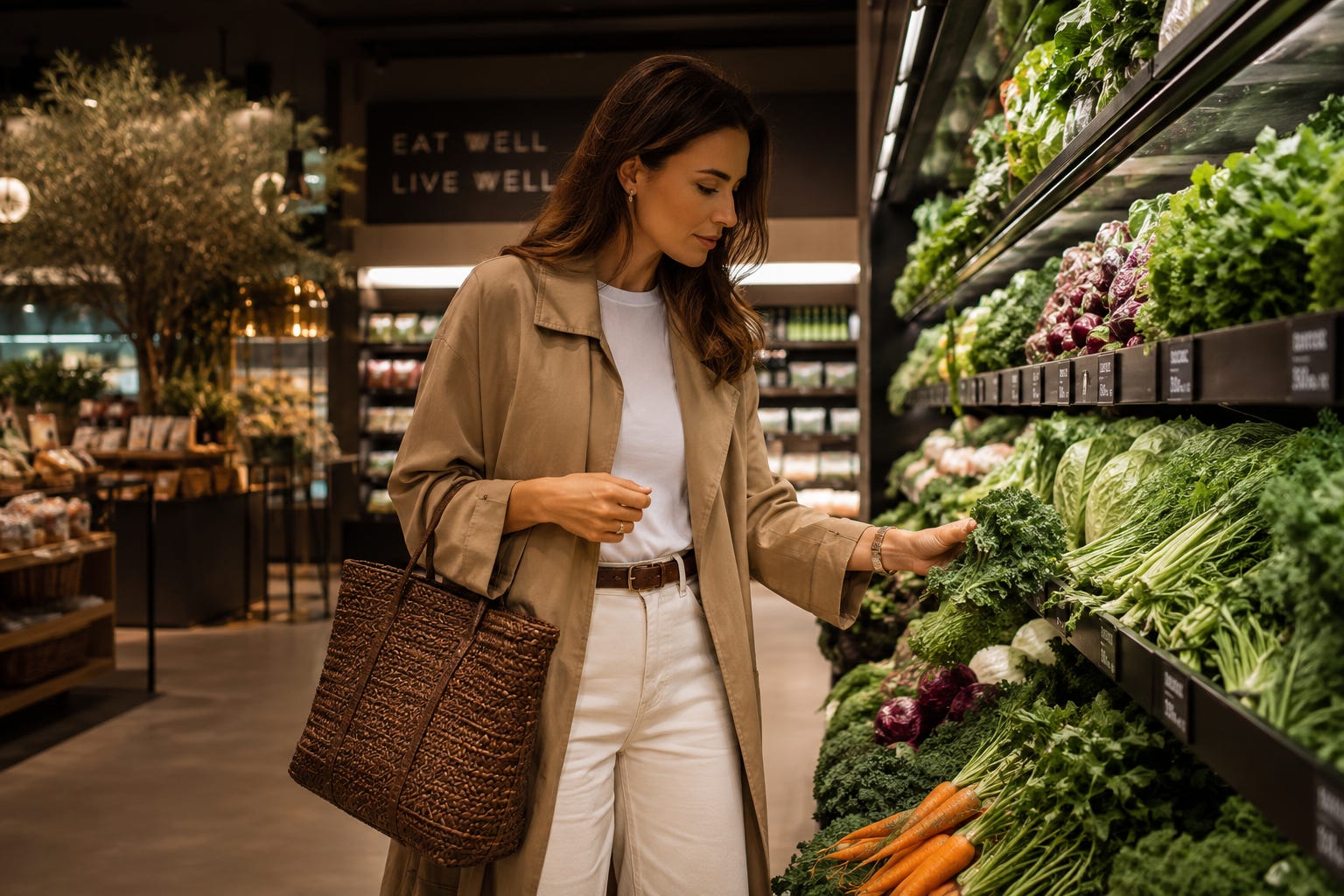
Image: A conscious woman selecting greens for her nourishment. Image generated through AI.
Today, speed shapes much of our relationship with food.
Ultra-processed meals. Constant availability. Eating while scrolling, moving, replying.
And yet, the human body remains remarkably ancient.
It still responds to rest, to balance, to quality over quantity, to consistency over excess.
Perhaps living well begins there.
We also live in an era increasingly shaped by the search for acceleration.
Faster results. Faster transformations. Faster solutions.
And while scientific progress has brought extraordinary advances, modern culture often seems less interested in building health slowly than in finding shortcuts to it.
Perhaps this is where nourishment offers a different lesson.
Longevity is rarely built through sudden correction. More often, it resembles a form of accumulation: habits, rhythms, choices repeated consistently over time.
Not unlike investing.
The body, too, appears to remember what it has been given - slowly, attentively, over years.
“Modern culture often seems less interested in building health slowly than in finding shortcuts to it.”
This is not an argument for perfection, nor a substitute for medical guidance.
Every body is different, and health decisions should always be discussed with qualified medical professionals. This reflection is not intended as medical advice, but as an invitation to think more consciously about the role that nourishment, rhythm, and care may play in how we live.
To choose well is also to nourish well.
And to nourish well often requires reclaiming something modern life continuously pressures us to abandon: time.
What rituals of nourishment help you feel most connected to yourself?
We would be glad to read your thoughts.