

Children are beginners all the time. They fall, mispronounce words, draw strange-looking animals and miss the ball completely. Nobody expects otherwise.
As adults, we are less forgiving with ourselves. We start learning a language and want to speak it. We pick up a tennis racket and are surprised by how difficult it is to send the ball in the intended direction. We try to draw and decide, rather quickly, that we cannot draw.
And yet, think of the satisfaction of becoming good at something that was once difficult.
It takes time.
This is obvious, of course. But in the current technological era, time has become an interesting part of the equation.
We have spent much of modern human history trying to make things faster.
Few of us would want to return to searching through shelves of encyclopaedias to find one piece of information, waiting weeks for a letter to cross an ocean or learning everything through trial and error.
Today, if we want to know something, the distance between the question and an answer can be almost non-existent.
And artificial intelligence has shortened it further, even on the most complex topics.
Ask about an obscure historical event, a provision of law, a medical term, how a combustion engine works or why Brunelleschi’s dome did not collapse and an answer appears.
Often it looks like a very good answer.
But the speed with which we can now reach an answer sometimes creates another problem: the feeling that reaching the answer means we have reached understanding.
Imagine asking AI about a medical test result.
Within seconds, an unfamiliar term can become comprehensible. We may understand what is being measured, what the normal range usually is and some of the reasons why our result might fall outside it.
We know considerably more than we did five minutes earlier.
But do we understand it as a doctor does?
Of course not.
And not simply because the doctor has access to information we do not have. A doctor has spent years, if not decades, studying how different systems interact and then years seeing what happens when that knowledge meets actual human beings. The test result is not an isolated piece of information. It belongs to a person, a history, symptoms, medications, probabilities, other results that might make one possibility more important than another.
What the machine cannot give us together with that answer is the decades of practical knowledge accumulated by a person, both individually and as part of teams of colleagues, through thousands and thousands of patients.
Law offers a similar temptation.
A legal question can now receive a remarkably sophisticated answer almost instantly. Legislation can be found, cases summarised, arguments presented on both sides.
It can be enormously useful. It also makes the law look much more ‘black-or-white’ than it is.
An experienced lawyer may read the same provision and immediately research and consider all the reasons why the apparent answer may not be the answer: another rule, an updated piece of regulation, an exception, a judgment, the hierarchy between two sources, a procedural issue, a fact that initially seemed irrelevant.
Seldom is the answer really simple. Knowing when it is not, and understanding why, come only with expertise.
And this is difficult to capture in a summary because expertise is not a collection of information: it comes with decades of constant training, study, and practice, on thousands and thousands of pages and on thousands of client cases.
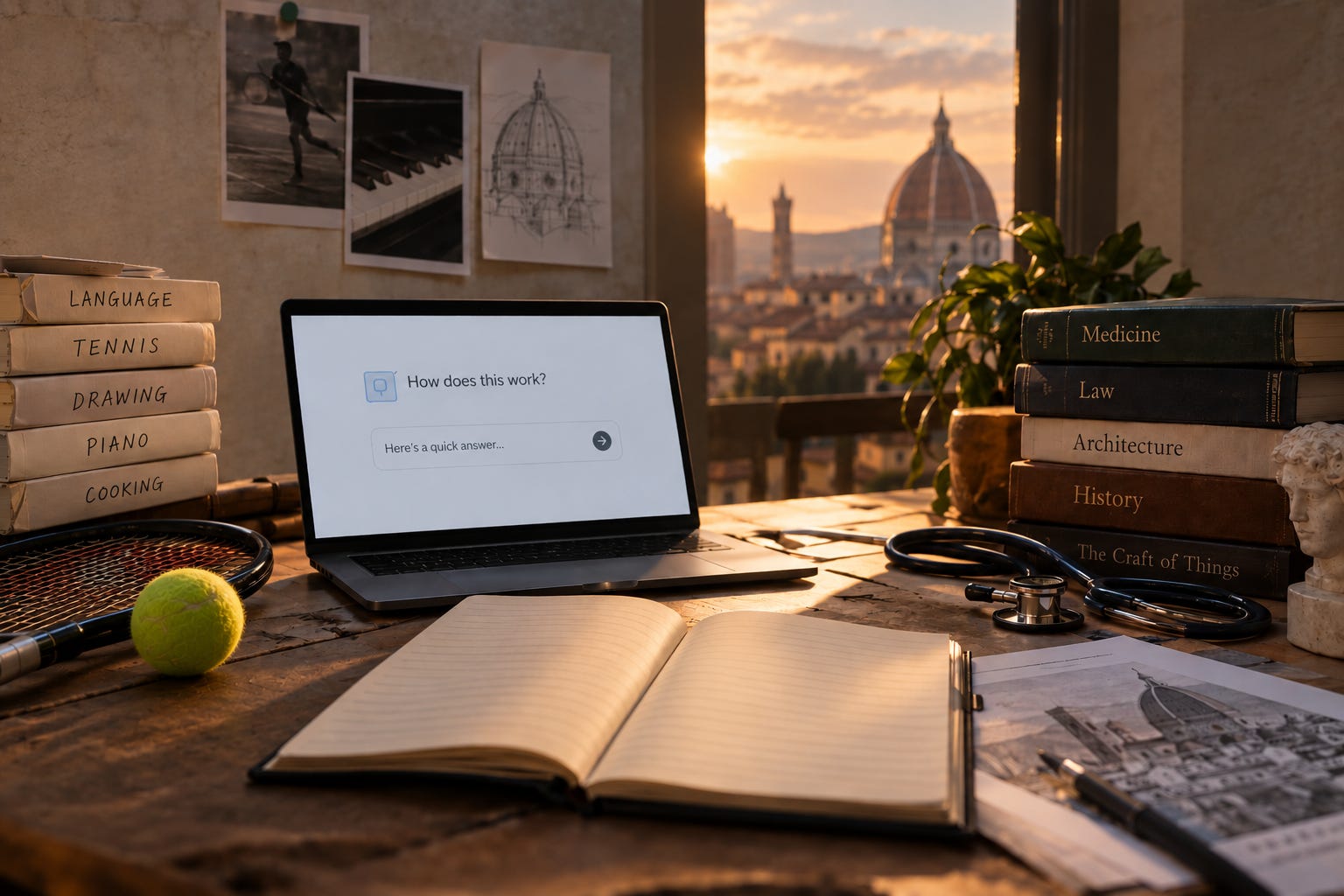
Image: A desk filled with books, a laptop, a notebook, a tennis racket, and objects representing different fields of knowledge, with the Brunelleschi’s dome in Florence in the background. Generated through AI.
The same thing happens in other fields.
Someone who has studied wine for twenty years does not merely know more facts about wine. They taste differently.
An architect sees things in a building that most of us walk past.
A craftsperson touches a material and notices something we would never think to look for.
The interesting part is that the years do not simply give an expert more answers.
They give them better questions.
This might be one of the things we risk forgetting when knowledge becomes so easy to access.
There is an enormous difference between I know nothing about this and I know something about this.
AI can help us cross that distance extraordinarily quickly.
The distance between I know something about this and I understand this deeply is another matter.
That second journey tends to be much less glamorous and there are no shortcuts to it.
The beginner might see the rule.
The expert has spent twenty years discovering all the circumstances in which the rule applies or not.
The interesting question is not whether AI makes us more superficial.
It may do precisely the opposite.
Imagine wanting to understand an unfamiliar subject twenty years ago. The first hours might have been spent simply working out where to begin. Today AI can explain the vocabulary, suggest what to read, show us competing positions and answer the embarrassing basic questions we might hesitate to ask an expert.
We can reach the interesting part much faster.
But then we have a choice.
We can take the explanation, feel that we understand, and move on.
Or we can become curious about what lies underneath it.
Perhaps the greatest opportunity AI gives us is exactly to gain time that we can spend going deeper into a topic after understanding it superficially.
And this brings us back to becoming good at something.
A piano teacher can explain exactly what our hands should do. Our hands still have to learn to do it, and our brain has to learn to coordinate them over hours of repetition.
Someone can explain the mechanics of a tennis serve. We still have to hit hundreds of bad ones before learning how to serve even one good one.
We can read something a lawyer wrote that looks ridiculously simple and discover, when we study and learn more about the theoretical and practical aspects of law, that there was a clear strategy behind it.
Time to really gain a skill remains irreducible.
It is the time in which information becomes experience.
That is also why there is such pleasure in going deeply into something.
The reward is not only that we become better at it. The topic itself becomes more interesting.
A building that once looked simply beautiful begins to reveal decisions about proportion, material and structure.
Music we had heard a hundred times contains something we had never noticed.
Two objects that once looked identical no longer do.
A sentence in another language carries a nuance we finally understand but cannot quite translate.
The more we know, the more there is to see.
That seems worth remembering at a time when we can know a little about almost anything.
There is nothing wrong with knowing a little. Curiosity often begins there.
The mistake may be thinking that because an initial answer came easily, the real answer must be equally simple - or even coincide with the initial answer.
Somebody may have spent thirty years learning what we have just read in thirty seconds.
Those thirty seconds are an extraordinary privilege.
But those thirty years carry a depth that only a person with that experience can fully navigate.
And not everything deserves that kind of investment from us.
As members of a society, we have the privilege to be able to rely on other people’s knowledge. On doctors, lawyers, engineers, historians, craftspeople, scientists, teachers and countless others who have chosen to spend years going somewhere we may have only briefly visited.
Perhaps choosing what we ourselves want to go deeply into is part of the pleasure.
A profession. A language. A craft. A sport. An obscure corner of history. How to make very good bread.
Something worth being a beginner at, then a little less of a beginner, and perhaps one day rather good.
AI can get us to the beginning faster than ever before.
It cannot make twenty years pass in twenty seconds.
And perhaps we should never want it to.
What is something you would still like to understand deeply?
We would be glad to read your thoughts.